Generations · · 7 min read
F1 vs F1B Goldendoodle: Coat, Shedding, and Temperament Differences
F1 vs F1B Goldendoodle: coat type, shedding, allergy friendliness, temperament, size, and price compared before you choose a puppy.
By Allen Lee, Founder · GoldendoodleInsurance.com
Last updated: · Reviewed by Allen Lee, Founder, Best Dog Insurance LLC
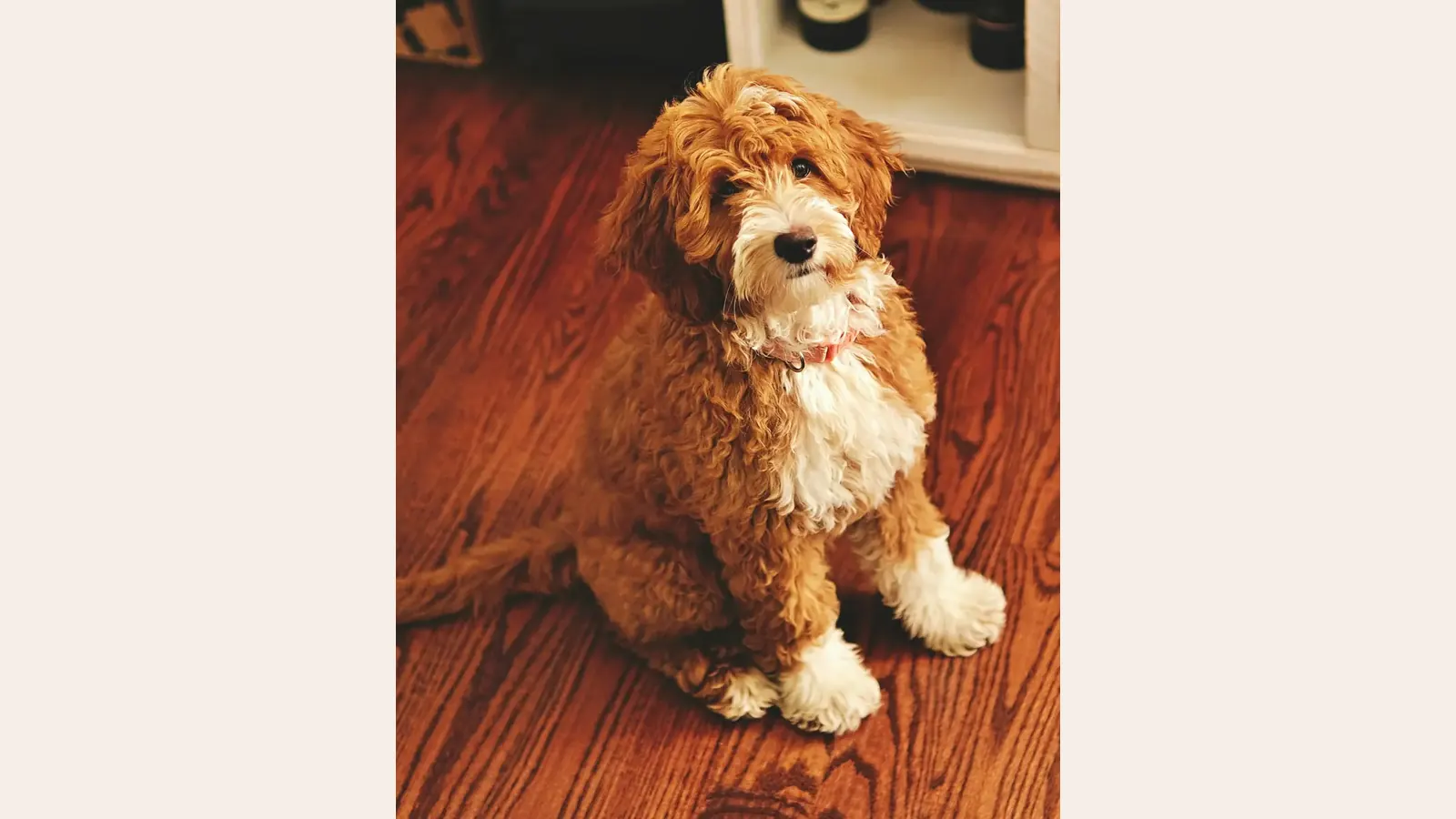
F1 and F1B are the two most common Goldendoodle generations, and the differences between them matter more than most buyers realize. Coat type, shedding, allergy friendliness, temperament, size, and price all shift depending on which one you bring home. Here's the complete F1 vs F1B Goldendoodle comparison.
| Trait | F1 Goldendoodle | F1B Goldendoodle |
|---|---|---|
| Genetic mix | 50% Golden / 50% Poodle | 25% Golden / 75% Poodle |
| Coat | Wavy, sometimes flat | Curly, often hypoallergenic |
| Shedding | Light to moderate | Minimal |
| Typical price | $1,800–$3,500 | $2,500–$5,000 |
| Hip dysplasia risk | Higher (~20%) | Lower (~12–15%) |
| Skin allergies | Lower | Slightly higher |
| Avg. monthly insurance | $35–$60 | $35–$60 |
Figures summarize published plan documents and national cost data reviewed in . Carrier terms, limits, and pricing change without notice and vary by state, pet age, and plan settings. This is not a quote or an offer of insurance — verify details directly with the provider.
Looking for insurance guidance specifically? This post focuses on coat, temperament, and lifestyle differences. For a full breakdown of premiums, hereditary risk, and coverage priorities for each generation, see our dedicated guides: F1 Goldendoodle Insurance and F1B Goldendoodle Insurance.
What Is an F1 Goldendoodle?
An F1 Goldendoodle is a first-generation cross, one purebred Golden Retriever bred to one purebred Poodle. The result is 50% Golden, 50% Poodle. F1 Goldendoodles are typically the most affordable generation and offer the strongest hybrid vigor (the genetic benefit of crossing two unrelated breeds).
What Is an F1B Goldendoodle?
An F1B Goldendoodle is an F1 Goldendoodle bred back to a purebred Poodle. The result is roughly 25% Golden, 75% Poodle. The extra Poodle genetics make F1B coats curlier, less shedding, and better tolerated by people with mild dog allergies.
F1 vs F1B Goldendoodle: Side-by-Side Comparison
| Trait | F1 Goldendoodle | F1B Goldendoodle |
|---|---|---|
| Genetics | 50% Golden / 50% Poodle | ~25% Golden / 75% Poodle |
| Coat | Wavy, sometimes straight | Curly, more uniform |
| Shedding | Low to moderate | Very low to non-shedding |
| Allergy-friendly | Variable — not guaranteed | Best choice for mild allergies |
| Grooming needs | Brush 2–3x/week | Brush daily; risk of matting |
| Hybrid vigor | Strongest | Reduced |
| Price (2026) | $2,000–$3,500 | $2,500–$4,500 |
| Temperament | Outgoing, more Golden-like | Slightly more reserved, Poodle-like |
Are F1 or F1B Goldendoodles Healthier?
It depends on which conditions you weight most heavily. F1 Goldendoodles benefit from the strongest hybrid vigor, which generally reduces severe disease incidence. But F1s also have the highest hip dysplasia rate among generations because they inherit equal Golden Retriever genetics.
F1Bs lose some hybrid vigor and pick up more Poodle-line conditions — Addison's disease, progressive retinal atrophy, and sebaceous adenitis. They also have slightly higher rates of skin and ear issues due to the curlier coat.
Neither generation is "healthier" on net. The full Goldendoodle health issues list applies to both.
Which Generation Is Best for People with Allergies?
F1B. The 75% Poodle genetics produce a curlier, less-shedding coat that traps dander rather than releasing it into the environment. That said, no Goldendoodle is fully hypoallergenic, dander, saliva, and urine still trigger reactions in moderately allergic people. F1Bs are the safer bet for mild allergies; F2B and multigen Goldendoodles bred from two F1B parents are the safest of all.
Do F1 and F1B Goldendoodles Cost the Same to Insure?
Premiums are within 5–10% of each other for the same age, size, and ZIP code. F1Bs sometimes get a slightly higher quote because of their higher Addison's and skin condition risk, while F1s can run higher in areas where orthopedic claims dominate. The bigger premium driver is size (Standard vs Mini) and enrollment age. Get specific numbers from our cost calculator.
Should I Get an F1 or F1B Goldendoodle?

- Choose F1 if you want a more outgoing temperament, lower price, easier grooming, and don't have allergy concerns.
- Choose F1B if someone in the household has mild allergies, you want minimal shedding, and you can commit to daily brushing.
Bottom Line
F1 vs F1B Goldendoodle comes down to coat priorities first, everything else second. Either generation makes a wonderful family dog — and either is insurable for similar money, as long as you enroll before health conditions appear. Compare providers in our Goldendoodle pet insurance comparison, and see the full generation breakdown in our generations guide.
Related Reading
- Goldendoodle insurance Buyer's Guide — compare top providers side-by-side
How Predictable Is the Coat in Each Generation?
Coat outcome is where the two generations differ most in practice, and it is a probability distribution rather than a guarantee. F1 Goldendoodles, one Golden Retriever parent, one Poodle parent, are heterozygous for the furnishings gene, so a single litter can produce flat, wavy, and curly puppies side by side. Roughly a quarter of F1 puppies inherit an improper coat that sheds noticeably like a Golden Retriever. F1B puppies, backcrossed to a Poodle and therefore about 75% Poodle, are far more likely to be homozygous for furnishings, which is why the great majority present a curly, low-shedding coat.
Breeders who DNA-test for the furnishings (RSPO2) and curl (KRT71) genes can tell you a specific puppy's genotype rather than a litter average, a request worth making if coat type is central to your decision. Our guide to Goldendoodle generations maps the full lineage chart.
What Are the Real Grooming Cost Differences?
Coat type sets the grooming bill, and over a lifetime the gap is larger than the difference in purchase price. A wavy F1 coat generally needs a professional groom every eight weeks at $70–$110, plus brushing two or three times a week. A dense curly F1B coat typically needs a groom every six weeks at $85–$140, plus near-daily line brushing to prevent matting that forces a shave-down. Annualized, that is roughly $600–$900 for a typical F1 against $850–$1,300 for a typical F1B. Matting is also a medical issue, not only a cosmetic one: severe mats trap moisture against the skin and are a documented contributor to the hot spots and secondary infections this breed is prone to.
Do Insurers Price F1 and F1B Goldendoodles Differently?
Underwriting is driven by size, age, breed classification, and postal code — not by generation. Most carriers file Goldendoodles as a single mixed-breed or designer-breed class, so an F1 and an F1B of the same adult weight, age, and location will be quoted nearly identically. Where generation does influence cost is indirectly, through adult size: an F1B bred down through a Miniature Poodle often matures 15–25 pounds lighter than a standard F1, and weight is a genuine rating factor. Compare the size-based ranges in our insurance cost by size breakdown.
Which Generation Fits Which Household?
Choose an F1 if you want the lower grooming commitment, are comfortable with some shedding, and value the wider genetic base of a true first cross. Choose an F1B if a household member reacts to dog dander, if a reliably curly non-shedding coat is a requirement rather than a preference, or if you want a smaller adult dog from mini-Poodle lines. In both cases the health documentation matters more than the label: OFA hips and elbows, a cardiac clearance, a CAER eye examination, and a prcd-PRA DNA panel on both parents affect your veterinary costs far more than the generation designation printed on the puppy contract.
Does Generation Affect Long-Term Health Costs?
Not in a way that supports a simple ranking. F1s benefit from heterosis, the broader genetic base of a first cross, but inherit full exposure to Golden Retriever risks including cancer, hip dysplasia, and bloat. F1Bs concentrate Poodle genetics, which lowers some of that exposure while raising the relative weight of Poodle-side conditions such as Addison's disease, patellar luxation in smaller lines, sebaceous adenitis, and progressive retinal atrophy. Both generations warrant comprehensive coverage enrolled before the first birthday; neither is reliably cheaper to treat over 12 years.
Frequently Asked Questions
What is the difference between F1 and F1B Goldendoodles?
An F1 Goldendoodle is 50% Golden Retriever and 50% Poodle (first-generation cross). An F1B is an F1 Goldendoodle bred back to a Poodle, making it ~25% Golden and 75% Poodle. F1Bs have curlier, less-shedding coats and are friendlier for mild allergies, while F1s have stronger hybrid vigor and lower prices.
Which is better for allergies, F1 or F1B Goldendoodle?
F1B is the better choice for people with mild allergies because the higher Poodle percentage produces a curlier, less-shedding coat that traps dander. No Goldendoodle is fully hypoallergenic — F2B and multigen Goldendoodles bred from two F1Bs are the safest options for allergy sufferers.
Are F1 or F1B Goldendoodles healthier?
Neither generation is meaningfully healthier overall. F1s have the highest hip dysplasia rate due to equal Golden Retriever genetics. F1Bs lose some hybrid vigor and pick up more Poodle-line conditions such as Addison's disease, PRA, and sebaceous adenitis.
Do F1 and F1B Goldendoodles cost the same to insure?
Insurance premiums for F1 and F1B Goldendoodles are within 5–10% of each other for the same age, size, and ZIP code. Size (Mini vs Standard) and enrollment age affect premiums far more than generation.
Wondering what coverage looks like for your Goldendoodle?
Compare plan options in a couple of minutes, or estimate your monthly premium first.
Get a free Goldendoodle insurance quote · Estimate your premium
Advertiser disclosure: GoldendoodleInsurance.com is an independent comparison website — not an insurance company, agency, or producer. We do not sell, issue, or bind policies. We may earn a commission when you click carrier links, at no cost to you. Advertising Disclosure · Editorial Policy.
Sources & References
Premium figures are sample quotes from public provider quoting tools and are illustrative only; medical details are summarized from the veterinary references below and are educational, not veterinary advice.
- American Kennel Club (AKC). Doodle Dog Generations Explained.
- Orthopedic Foundation for Animals (OFA). Poodle vs. Golden Retriever Hip Statistics.
Pricing sources and data vintage
Cost figures on this page are national ranges, not quotes. Each one below is tied to a named publisher and the date we last verified it. Pricing data set: . Next scheduled re-verification: February 2027.
| Figure | Published range | What it covers | Source & date verified |
|---|---|---|---|
| Monthly premium, Goldendoodle accident & illness plan | $25–$70/month | Quotes sampled across ten U.S. carriers for Mini/Medium/Standard profiles at 80–90% reimbursement, $250–$500 annual deductible. Mid-range figure ≈ $45/month. | NAPHIA (North American Pet Health Insurance Association) — State of the Industry Report — average U.S. premiums by coverage type (2026 report). Verified Aug 2026. |
| Hip dysplasia surgery (FHO or total hip replacement) | $3,500–$7,000 per hip | Specialty and teaching-hospital surgical pricing, single hip, including imaging, implant, anesthesia, and post-op rehab. | American Veterinary Medical Association (AVMA) — Cost of veterinary care references / orthopedic procedure benchmarks (2026 guidance). Verified Aug 2026. |
| Bloat (GDV) emergency surgery | $3,000–$7,500 | Emergency gastric decompression, derotation, and gastropexy with 24-hour critical care. Overnight ICU drives the upper end. | Merck Veterinary Manual — Gastric dilation and volvulus in dogs (Current edition, 2026). Verified Aug 2026. |
| Addison's disease (hypoadrenocorticism) maintenance | $200–$500/month | Desoxycorticosterone pivalate injections or fludrocortisone plus prednisone, with periodic electrolyte monitoring. Dose scales with body weight. | American College of Veterinary Internal Medicine (ACVIM) — Consensus statement on canine hypoadrenocorticism (Consensus statement, latest revision). Verified Aug 2026. |
| Lifetime veterinary spend, Goldendoodle | $15,000–$30,000 | Routine care plus expected illness and emergency claims across a 10–14 year lifespan, before insurance reimbursement. | American Veterinary Medical Association (AVMA) — Pet ownership and cost-of-care data (2026 guidance). Verified Aug 2026. |
Veterinary pricing varies by region, clinic type, and case complexity; insurance premiums vary by ZIP code, age, deductible, and reimbursement level. Treat every range as a planning benchmark and confirm current pricing with your veterinarian and current premiums with the provider. Our sourcing rules are documented in the editorial policy.